

GET MORE INFORMATION
What Should Buyers Know About Older Boathouses and Docks in Muskoka? A Guide to Cribs, Steel Docks, Wood Docks & Waterfront Regulations
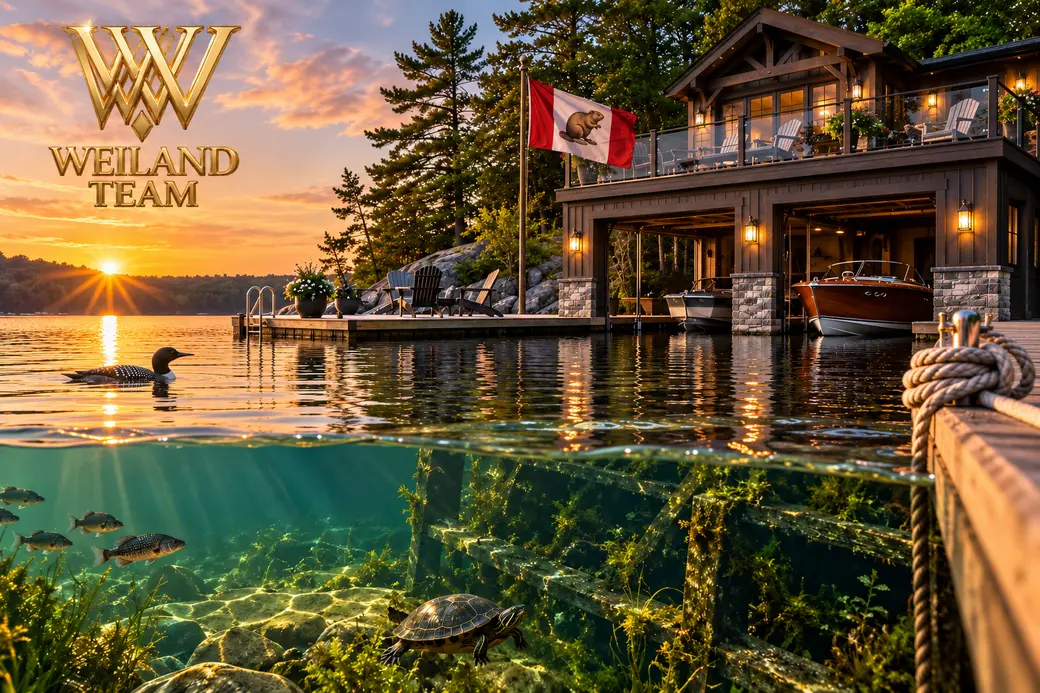
What Should Buyers Know About Older Boathouses and Docks in Muskoka?
A Buyer’s Guide to Cribs, Steel Docks, Wood Docks, Environmental Considerations & Waterfront Regulations
An older Muskoka boathouse can be one of the most charming and valuable features of a waterfront property. But before falling in love with a beautiful old boathouse, buyers should understand what is supporting it, what condition it is in, whether it can legally be repaired or replaced, and what environmental and municipal requirements could affect future work.
The same applies to docks. A dock may look perfectly serviceable from above while the cribbing, steel supports, piles, connections or underwater components tell a very different story.
For buyers considering an older Muskoka waterfront property, the important question is not simply, “What is here today?” It is also, “What will I be permitted to repair, replace or rebuild in the future?”
Why Older Muskoka Boathouses Deserve Special Attention
Many Muskoka waterfront properties have boathouses and docks that were constructed decades ago. Some may predate today's zoning standards, building requirements or environmental regulations.
An existing structure may have significant value precisely because its size, location, setbacks or use might not necessarily be permitted for a completely new structure today.
That does not automatically mean an older structure is illegal. It may be legally existing or legally non-complying. However, buyers should never assume that because a boathouse exists today, it can automatically be demolished and reconstructed exactly as it stands.
Before purchasing, buyers should investigate:
- When the boathouse and dock were constructed
- Whether building permits or historical approvals are available
- Whether the structure is legally existing or legally non-complying
- Whether previous additions were permitted
- Whether living accommodations exist above or within the boathouse
- Whether those accommodations are legally recognized
- Whether the Original Shore Road Allowance is owned
- Whether provincial or federal approvals affect the structure
- What could legally be repaired, reconstructed or replaced
The Most Important Question May Be What You Can Do With It
A large older boathouse can contribute significantly to the appeal and value of a Muskoka property. This is particularly true when it occupies a desirable location close to the water, has substantial docking capacity or contains legally recognized upper-level space.
However, buyers should be cautious about assigning replacement value to an existing structure until they understand what could actually be rebuilt under current rules.
For example, if an older boathouse were substantially damaged or required major reconstruction, current zoning, building, shoreline ownership and environmental requirements could become extremely important.
This is why municipal records and professional advice can be an important part of waterfront due diligence.
Look Under the Dock — Not Just at the Decking
When buyers walk onto a dock, their attention naturally goes to the decking, the view and where the boat will be tied up.
But decking is only the visible surface.
The structural system underneath may include timber cribs, steel framing, piles, posts, anchors, concrete blocks or other supporting components.
On an older dock, buyers should consider having the underwater and structural components evaluated where appropriate. Potential concerns can include deteriorated timber, movement in crib structures, corrosion, weakened connections, damaged welds, shifting caused by ice and deterioration that cannot easily be seen from above.
What Is a Crib Dock?
Traditional crib docks are common on older Muskoka waterfront properties. A crib generally consists of a timber framework positioned on the lakebed and traditionally filled with rock to create a substantial support structure.
Well-built cribs can last for many years, but eventually timber components can deteriorate.
Repairing or replacing crib structures is not necessarily the same as replacing a few deck boards. Structural work can trigger building permit and environmental requirements.
The Township of Muskoka Lakes, for example, states that structural repair or replacement of cribs or stringers requires a building permit in applicable circumstances, and structural components supporting a boathouse may require professional engineering or qualified structural design.
Buyers can review current information through the Township of Muskoka Lakes Building Department.
Our Own Experience: Replacing Older Cribs With Steel
Mark & I have experienced this ourselves on our own Muskoka waterfront.
We had older crib structures supporting part of our waterfront area. As they aged, we eventually made the decision to replace them with steel. For us, longevity was an important consideration.
That experience reinforced something we often tell waterfront buyers: what you see above the water is only part of the story.
A beautiful dock or boathouse may still require significant investment underneath. Understanding the support system and its condition before purchasing can help buyers anticipate future maintenance and capital costs.
Steel Docks vs. Wood and Crib Construction
There is no single dock system that is automatically best for every Muskoka property. Water depth, lakebed conditions, exposure, ice movement, intended use and whether the dock supports a boathouse can all influence the appropriate construction method.
Steel-Supported Docks
Steel can provide substantial structural support and longevity when properly designed and installed. However, buyers should still investigate corrosion, welds, connections and underwater structural components.
Where a steel dock supports a boathouse or other upper structure, engineering and inspection requirements may apply.
Timber Crib Docks
Traditional crib docks can be extremely substantial and are part of the character of many older Muskoka properties. However, the condition of the timber, crib structure and lakebed should be considered carefully.
Major crib repair or replacement can also involve more environmental and regulatory considerations because the structure interacts directly with the lakebed.
Floating, Post, Pile and Other Dock Systems
Depending on the property, other systems may reduce the amount of physical contact with the lakebed. Fisheries and Oceans Canada currently provides guidance for residential docks and boathouses that are floating or supported by systems including pipes, piles, poles, anchors, concrete blocks and cantilever arms.
For current federal guidance, buyers and owners can consult Fisheries and Oceans Canada: Boathouses, Docks and Moorings.
Older Docks Can Become Part of the Aquatic Environment
This is one of the most overlooked aspects of buying an older waterfront property.
An old crib or dock has often been in the water for decades. During that time, the surrounding area may have become habitat for fish and other aquatic organisms. Vegetation may have developed around it, and fish or wildlife may use areas beneath and around the structure.
That means removing an old crib is not necessarily as simple as pulling out the timber and rocks and installing something new.
Fisheries and Oceans Canada identifies disturbance of the lakebed and banks, sediment release and changes to aquatic habitat as potential impacts of dock and boathouse construction, maintenance and repair.
Under the federal Fisheries Act, activities in or near water must avoid unauthorized harmful impacts to fish and fish habitat.
Learn more through Fisheries and Oceans Canada's Codes of Practice for Projects Near Water.
Do Not Assume Rocks From an Old Crib Can Simply Be Moved
This is another important consideration.
Natural rocks, woody material, aquatic vegetation and other features around an established dock may contribute to aquatic habitat. Removing or relocating lakebed material can create environmental issues.
Before altering an older crib or disturbing the lakebed, owners should determine what approvals and environmental protections apply to the specific project.
Depending on the work, professional environmental advice may also be appropriate.
What About Turtles, Fish and Other Wildlife?
Muskoka waterfront is shared with an extraordinary variety of wildlife. Depending on the property and location, buyers may encounter fish habitat, turtles, waterfowl, beavers and other species around the shoreline.
If wildlife or potential habitat is discovered around a dock, boathouse or shoreline area, owners should not simply remove or relocate animals or disturb habitat without first determining the applicable requirements.
Federal protections may apply to fish and aquatic species, while provincial legislation and regulations can apply to other wildlife and species at risk.
Environmental considerations can also affect when and how in-water work is performed.
We Even Had Beavers Move In
Waterfront ownership can occasionally bring some very unexpected experiences.
At one point while Mark & I were away, beavers became remarkably active around our waterfront area. We ultimately had eleven beavers involved in the area.
It was certainly not an everyday Muskoka ownership experience, but it demonstrated how quickly wildlife can change a shoreline environment. We sought assistance so the animals could be dealt with appropriately and moved to a safer area. It was also an unexpected and significant expense.
Sometimes Waterfront Ownership Comes With Surprises
Mark & I learned firsthand that Muskoka wildlife can occasionally have its own plans for your waterfront.
We once went away for only four or five days. When we returned, we discovered that beavers had been extremely busy around our dock. Somehow, they had taken lines from the side of our boat and incorporated them into an enormous, very cleverly constructed dam directly in front of the boat.
We couldn't help but admire their workmanship — although it took us hours to carefully disassemble what they had created just so we could get the boat out!
We later discovered that we had an unusually large amount of beaver activity around our waterfront area. Ultimately, professional assistance was required to deal with the situation appropriately, and it became an unexpected expense of waterfront ownership.
It's certainly not something most Muskoka cottage owners will ever experience, but it remains one of our more memorable waterfront stories. It also illustrates an important point for buyers: when you own waterfront in Muskoka, you are sharing the shoreline with nature.
Fish, turtles, beavers, waterfowl and other wildlife may use areas around docks, cribs and shorelines as habitat. Before altering habitat, removing established structures or undertaking significant shoreline work, owners should determine what environmental protections and regulations apply and obtain professional guidance where necessary.
Most waterfront owners will never experience anything quite like that. But it illustrates a larger point: when you own waterfront, you are sharing that shoreline with nature. Wildlife, changing water conditions and the aquatic environment can occasionally create maintenance and management issues that simply do not arise with an ordinary residential property.
Where wildlife management is required, property owners should obtain current advice from the appropriate authorities or qualified professionals rather than attempting relocation or habitat alteration themselves.
Fish Habitat Can Affect Waterfront Work
Fish habitat should be considered before undertaking significant in-water work.
Construction activity can potentially disturb spawning areas, aquatic vegetation, sediment and other habitat features. Depending on the location and proposed work, timing restrictions or additional environmental measures may apply.
Fisheries and Oceans Canada provides current guidance on avoiding harmful impacts to fish and fish habitat through its Boathouses, Docks and Moorings Code of Practice.
Original Shore Road Allowances Can Matter
Another issue buyers should investigate is ownership of the Original Shore Road Allowance, often called the OSRA.
Depending on the municipality and proposed project, ownership of the shore road allowance can affect the ability to obtain permits for shoreline structures.
For example, the Township of Muskoka Lakes changed its policy in 2026 so that boathouses are no longer exempt from certain OSRA ownership requirements before a building permit is issued, although a conditional permit process may be available for eligible projects while an approved OSRA purchase is proceeding.
Current information is available through the Township of Muskoka Lakes shoreline and boathouse guidance.
Living Space Above an Older Boathouse Requires Extra Due Diligence
An older two-storey boathouse with accommodation above can be extremely desirable.
But buyers should establish whether the upper level and its use are legally recognized.
A bedroom, bathroom, kitchen, sauna or living area existing physically within a boathouse does not by itself establish that the use was legally approved.
Municipal records, building permits, zoning information and, where applicable, provincial occupational authority should be investigated before buyers rely upon that space when evaluating the property.
Questions Buyers Should Ask About an Older Muskoka Boathouse or Dock
- How old are the boathouse and dock?
- What type of structure supports the dock?
- Are there timber cribs, steel supports, piles or another system?
- When were the underwater components last inspected?
- Are there signs of rot, corrosion, movement or ice damage?
- Are historical building permits available?
- Is the existing structure legally recognized?
- Is any accommodation above the boathouse legally permitted?
- Is the Original Shore Road Allowance owned?
- Would major repairs require a permit?
- Could the existing structure be reconstructed in its current size and location?
- Could fish habitat or other environmental considerations affect future work?
- What is the approximate cost of anticipated dock or boathouse work?
Should Buyers Have an Older Dock or Boathouse Professionally Inspected?
For a significant older structure, it can be worthwhile.
A general cottage inspection may not provide a detailed assessment of submerged cribs, piles, steel supports or structural components beneath a boathouse.
Depending on the structure, buyers may wish to consult an experienced dock or boathouse contractor, structural engineer or other qualified professional.
The cost of replacing a major waterfront structure can be substantial, making this an area where good due diligence can be particularly valuable.
Frequently Asked Questions About Older Muskoka Boathouses and Docks
Can I rebuild an old Muskoka boathouse exactly as it is today?
Not necessarily. Existing structures may benefit from legal existing or legal non-complying status, but reconstruction can be subject to current municipal zoning, building requirements, shoreline ownership and other approvals. Buyers should verify the specific property before assuming an existing structure can be recreated.
Are crib docks still allowed in Muskoka?
Requirements depend on the municipality, proposed design, amount of lakebed contact and applicable provincial and federal requirements. New construction or major structural work should be reviewed with the appropriate municipality and regulatory authorities before proceeding.
Is a steel dock better than a wood crib dock?
Not automatically. Each system has advantages and considerations. Site conditions, water depth, lakebed, ice movement, engineering requirements, intended use and whether the dock supports a boathouse should all be considered.
Do I need a permit to repair an old dock?
It depends on the work and municipality. Replacing decking may be treated differently from repairing or replacing structural cribs, stringers, piles or steel components. Always check current municipal requirements before starting structural work.
Can fish habitat affect dock replacement?
Yes. Work in or near water can potentially affect fish and fish habitat. Fisheries and Oceans Canada provides specific codes of practice and guidance for docks, boathouses and other projects near water.
Should I inspect an older boathouse before buying a Muskoka cottage?
Where a boathouse or substantial dock represents an important part of the property's value, buyers should consider appropriate professional inspections and investigate permits, structural condition and legal status as part of their due diligence.
The Weiland Team Perspective
Older boathouses are part of what makes Muskoka waterfront so special. Some have stood along these lakes for generations and are an important part of the character and value of a property.
But charm and history should be balanced with good due diligence.
When Mark & I help buyers evaluate Muskoka waterfront, we look beyond the cottage itself. The boathouse, dock, shoreline, water depth, exposure, lakebed, access and future usability can all influence both enjoyment and value.
Our own experiences with older crib structures, replacing them with steel and even dealing with unexpected wildlife issues have reinforced how important it is to understand the entire waterfront — above and below the waterline.
A beautiful old boathouse can be an extraordinary asset. The key is knowing exactly what you are buying.
Thinking About Buying Muskoka Waterfront?
If you are considering a cottage with an older boathouse, dock or other waterfront structures, Mark & I would be happy to help you understand the questions worth asking before you purchase.
Your Muskoka Dream Starts With The Weiland Team.
Weiland Team | eXp Realty
Luxury Muskoka Waterfront Real Estate
Live • Invest • Explore
This article is intended for general information only. Municipal bylaws, environmental requirements, building regulations and individual property circumstances vary and can change. Buyers and property owners should confirm current requirements with the applicable municipality, government agencies and qualified professionals before undertaking waterfront construction, repair, wildlife management or habitat disturbance.
Categories
Recent Posts