

GET MORE INFORMATION
What Buyers Need to Know About Conservation Authorities, Shoreline Permits, and Tree Cutting in Muskoka
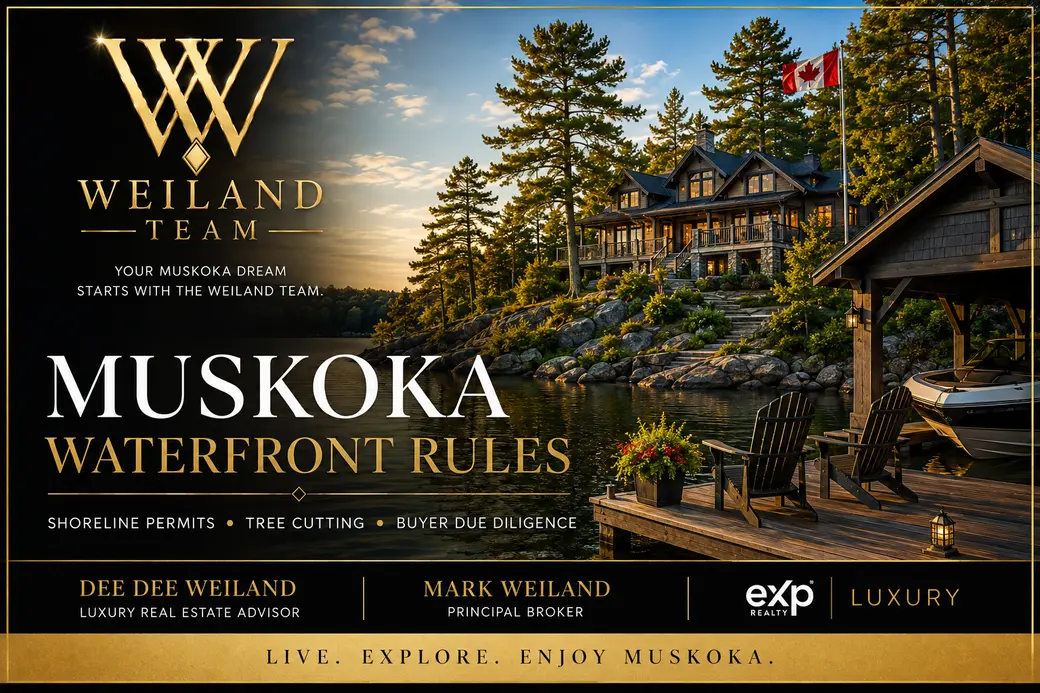
What Buyers Need to Know About Conservation Authorities, Shoreline Permits, and Tree Cutting in Muskoka
One of the things that makes owning a cottage in Muskoka so special is the natural setting — mature trees, rocky shorelines, beautiful views and the feeling that the cottage belongs in the landscape.
But when you buy waterfront property, owning the land does not necessarily mean you can make every change you might envision.
Removing trees to open up a view, changing the grade of the land, creating a new path to the water, adding a retaining wall, rebuilding a dock or constructing a boathouse can all involve municipal rules, permits or other approvals.
And those requirements can vary depending on where in Muskoka the property is located, what is being proposed and the characteristics of the particular property.
For buyers, this is something worth understanding before purchasing a cottage — particularly if part of the attraction is what you believe you will be able to change later.
Can You Change the Shoreline of a Muskoka Cottage After You Buy It?
Possibly, but buyers should never assume that a waterfront property can be altered simply because they own it. Shoreline development, vegetation removal, grading, docks, boathouses and other improvements can be subject to municipal planning rules, building permits and, depending on the project, approvals from other government agencies.
This becomes particularly important when a buyer walks a property and immediately starts imagining the possibilities.
Perhaps you would like to remove several trees to improve the lake view, create a larger sitting area near the water, build new stairs down a steep lot, replace or enlarge the dock, construct a boathouse, add a retaining wall or create a more open shoreline.
Some of those ideas may be possible. Others may require permits or professional planning advice, and some may be restricted.
The important thing is to find out before your purchase decision depends on them.
Why Are Muskoka Shorelines Protected?
Natural shorelines are a significant part of what gives Muskoka its character, but their importance goes well beyond appearance.
Trees, shrubs and other vegetation along the waterfront help stabilize soil, manage runoff, provide wildlife habitat and protect water quality. Municipal planning policies throughout Muskoka therefore place considerable emphasis on maintaining natural vegetation along shorelines.
The details vary by municipality, which is why a rule that applies to a cottage in the Township of Muskoka Lakes should not automatically be assumed to apply in exactly the same way to a property in Huntsville, Bracebridge, Gravenhurst, Lake of Bays or Georgian Bay.
Can You Cut Trees on a Muskoka Waterfront Property?
Sometimes, but tree removal on waterfront property can be regulated, and buyers should confirm the rules that apply to the specific property before removing trees. The municipality, location of the tree, its size and condition, proximity to the shoreline and reason for removal can all matter.
This is an area where assumptions can cause problems.
A beautiful cottage may have a somewhat filtered lake view, and a buyer may think, “We can just take out those three trees after closing.”
That should never be assumed.
For example, in the Township of Muskoka Lakes, the Tree Conservation and Site Alteration By-laws apply to specified lands, including lands within 300 feet of a navigable waterway in the Waterfront designation. The Township identifies exemptions for certain circumstances, but a Tree Cutting Permit may be required when an exemption does not apply.
Township of Muskoka Lakes: Tree Conservation and Site Alteration
Bracebridge has its own rules. Its current Tree Cutting By-law regulates certain trees on specified lands, including lands within 60 metres of the high-water mark of a navigable waterway. Depending on the circumstances, notification or a permit may be required before a regulated tree is removed.
Town of Bracebridge: Tree Cutting and Preservation
For buyers, the takeaway is simple:
Do not value a waterfront property based on a view you assume you will be able to create later.
If removing particular trees is important to your enjoyment of the property, investigate that question before committing to the purchase.
What About Pruning Trees to Improve the View?
Selective pruning may be treated differently from removing an entire tree, but it is still important to understand the rules that apply to the property.
Thoughtful pruning can sometimes improve sightlines while maintaining the natural character and health of the shoreline. Aggressive cutting or damaging a tree, however, is not necessarily the same thing as ordinary pruning.
If improving the view is an important part of your plans, it is much better to determine what is permitted than to make assumptions based on what neighbouring properties may have done.
What Is Site Alteration — and Why Does It Matter?
Site alteration generally means changing the land itself, such as placing fill, removing soil or changing the grade. Depending on the municipality and property, this type of work can also be regulated.
This can become relevant when buyers envision levelling an area for outdoor living, changing drainage, creating or widening pathways, modifying a slope, installing landscaping, constructing certain shoreline improvements or moving soil or fill.
In the Township of Muskoka Lakes, for example, its Site Alteration By-law regulates activities including the placing of fill, removal of soil and alteration of grade on lands subject to the by-law. A permit may be required depending on the work proposed and whether an exemption applies.
This is why one of the most useful questions a Muskoka buyer can ask is not simply, “Do I like this property?” but also:
“Will this property allow me to do the things that matter to me in the future?”
What If You Want to Build or Replace a Dock or Boathouse?
Docks and boathouses can be a major part of both the lifestyle and value of a Muskoka waterfront property, so future plans for these structures deserve careful attention before buying.
The fact that a property currently has a dock or boathouse does not automatically mean that a buyer could replace it in exactly the same size, location or configuration in the future.
Existing structures, planning requirements, shoreline frontage, setbacks, lot coverage, environmental considerations and other approvals may all become relevant.
For a more detailed look at this subject, see our related article: What Buyers Need to Know About Docks, Boathouses and Waterfront Structures in Muskoka.
A 2026 Muskoka Lakes Change Buyers Should Know About
Waterfront rules and municipal policies can change, which is one reason current due diligence is so important.
In the Township of Muskoka Lakes, Council approved changes to its Sale of Shore Road Allowances and Road Allowances Policy on June 10, 2026.
Under the updated policy, boathouses are no longer exempt from the Township’s Original Shore Road Allowance requirements. Where the requirement applies, the Original Shore Road Allowance must be owned by the property owner before a building permit to construct a boathouse can be issued.
The Township has also introduced a potential Conditional Building Permit Agreement for eligible property owners whose Original Shore Road Allowance purchase has received initial approval and is still being completed.
Township of Muskoka Lakes: Planning a Boathouse or Shoreline Project? Here’s What You Need to Know
The Township also notes that some shoreline projects may involve additional approvals from provincial or federal agencies, depending on the nature and location of the proposed work.
What Is an Original Shore Road Allowance?
Original Shore Road Allowances — often shortened to OSRAs — are an important and sometimes surprising part of Muskoka waterfront ownership.
Historically, road allowances were reserved along the shores of many Ontario lakes. In some cases, that strip of land between the cottage property and the water has subsequently been closed and conveyed into private ownership. In other cases, it has not.
That means the shoreline immediately in front of a cottage may not always be owned in the way a buyer initially assumes.
Ownership of the Original Shore Road Allowance can become particularly important when considering future shoreline structures or improvements.
For buyers, confirming whether the shore road allowance is owned — and understanding the implications if it is not — should be part of waterfront due diligence.
Don't Assume That Existing Means Approved
Another important distinction when looking at an older Muskoka cottage is the difference between something being existing and understanding its legal or permitting status.
Muskoka has cottages and shoreline structures that have been standing for decades. That history can sometimes create complicated situations.
If a property has an older dock, boathouse, bunkie, deck, retaining wall or other structure that is important to your decision, it may be worthwhile investigating its status rather than assuming that because it is physically there, everything associated with it has necessarily been approved.
This becomes particularly important if your future plans involve renovating, enlarging, rebuilding or replacing the structure.
The Municipality Matters
“Muskoka” may feel like one market, but waterfront properties are located within different municipalities, each with its own planning framework and development requirements.
Depending on location, a property may fall within:
- Town of Huntsville
- Town of Bracebridge
- Town of Gravenhurst
- Township of Lake of Bays
- Township of Muskoka Lakes
- Township of Georgian Bay
District, provincial and federal requirements may also be relevant depending on the property and the work being proposed.
That is why we are cautious about giving buyers a universal answer to questions such as:
“Can I build a boathouse?”
“Can I cut these trees?”
“Can I landscape down to the water?”
“Can I rebuild those stairs?”
The better answer is:
Let’s investigate what applies to this particular property and this particular project.
What Should Buyers Check Before Purchasing?
If future improvements are important to your decision, identify them while you are still evaluating the property.
Ask yourself:
What would I want to change if I owned this cottage?
Maybe you love the cottage but only if you can improve the view.
Perhaps the steep pathway works today, but you expect to need easier access in the future.
Maybe a boathouse is essential to the way your family wants to enjoy the property.
Or perhaps you love the cottage exactly as it is and have no intention of making major changes.
Those are very different purchasing scenarios.
When a proposed change is important enough that it affects whether you would buy the property, it may be appropriate to speak with the municipality and, depending on the issue, a qualified planner, lawyer, surveyor, contractor, arborist or other appropriate professional before relying on the assumption that the work can be done.
Why This Matters Beyond Permits
This is not simply about complying with municipal rules.
It is about buying the right property.
A cottage can be beautiful and still not be suitable for what you ultimately want to do with it.
Understanding shoreline restrictions before purchasing can help you evaluate whether the property fits your long-term plans, whether anticipated improvements are realistic, potential future costs, whether existing structures deserve further investigation and whether the property will continue to work for your family over time.
The best waterfront purchase is not necessarily the property with the most dramatic first impression.
It is the property where the lake, land, cottage and rules surrounding them work together for the lifestyle you want to create.
Frequently Asked Questions
Can I cut trees to improve the view from a Muskoka cottage?
Possibly, but you should never assume that you can. Tree removal and vegetation alteration can be regulated, particularly near the waterfront. Requirements vary by municipality and may depend on the tree, its location and the reason for removal. If particular trees affect your purchasing decision, confirm what is permitted before buying.
Do I need a permit to landscape near the water in Muskoka?
It depends on the municipality, property and proposed work. Grading, moving soil or fill, removing vegetation and other forms of site alteration may be regulated. Buyers and property owners should confirm the requirements that apply to the particular property before beginning significant shoreline work.
Can I build a new boathouse after buying a Muskoka cottage?
Not necessarily. Whether a boathouse is permitted can depend on the municipality, planning rules, shoreline frontage, existing development, setbacks, lot characteristics, ownership of an Original Shore Road Allowance and other approvals. If a future boathouse is important to your purchase, its feasibility should be investigated before buying.
Does every Muskoka municipality have the same waterfront rules?
No. Huntsville, Bracebridge, Gravenhurst, Lake of Bays, Muskoka Lakes and Georgian Bay have their own planning frameworks and development requirements. Other levels of government may also have a role depending on the property and proposed project.
If a dock or boathouse already exists, can I automatically replace it?
No assumption should be made. Existing shoreline structures may have historical approvals, legal non-conforming status or other circumstances that affect what can be repaired, replaced, enlarged or rebuilt. If the structure is important to your buying decision, its status and redevelopment potential should be investigated.
What should I do if future renovations are important to my cottage purchase?
Identify the changes you consider essential before purchasing. Depending on the project, consider confirming feasibility with the municipality and appropriate professionals such as a planner, lawyer, surveyor, contractor or arborist. This is particularly important when your decision to purchase depends on being able to make a specific change.
Buying Waterfront Property in Muskoka
Buying a Muskoka cottage involves much more than choosing a beautiful cottage on a beautiful lake.
At the Weiland Team, we help buyers look beyond the first impression and understand the practical details that can influence how a waterfront property can be enjoyed, improved and owned over the long term.
Dee Dee Weiland, Luxury Real Estate Advisor, brings a background in interior design and professional staging, helping buyers look at both the possibilities and practical considerations of a property.
Mark Weiland, Principal Broker, brings extensive business and negotiation experience to the buying process.
Together, we help buyers evaluate the cottage, waterfront, location, access, property condition, value and long-term suitability so they can make an informed decision about whether a property is truly right for them.
Whether you're considering a cottage in Huntsville, Bracebridge, Gravenhurst, Lake of Bays, Muskoka Lakes or the surrounding Muskoka area, we're here to help you navigate the details that make waterfront real estate different.
Your Muskoka Dream Starts With The Weiland Team.
This article is intended for general educational purposes and should not be considered legal, planning or building advice. Municipal requirements and policies can change, and requirements applicable to a particular waterfront property should be independently confirmed with the appropriate municipality, government agency and qualified professionals.
Categories
Recent Posts