

GET MORE INFORMATION
What Buyers Need to Know About Private Roads, Road Associations, and Maintenance Agreements in Muskoka
What Buyers Need to Know About Private Roads, Road Associations, and Maintenance Agreements in Muskoka
When buyers fall in love with a Muskoka waterfront property, the road leading to it can feel like a minor detail.
It is not.
Private roads are common throughout cottage country, and they can work extremely well. But buyers need to understand exactly how access is provided, who maintains the road, how costs are shared and whether there are written agreements in place.
A beautiful cottage at the end of a winding private road may be a wonderful fit for your family.
But before you buy, you should understand the road almost as carefully as you understand the cottage itself.
What Is a Private Road?
A private road is generally a road that is not maintained as a public municipal road.
That distinction matters because responsibilities that would normally fall to a municipality may instead fall to the property owners who use the road.
Depending on the property, that can include:
- Grading
- Gravel
- Snow plowing
- Sanding
- Drainage
- Culvert repair
- Tree clearing
- Brush maintenance
- Road resurfacing
- Emergency repairs
The Township of Muskoka Lakes maintains municipal roads within its jurisdiction, but a private road does not necessarily receive those same municipal maintenance services.
Review Township of Muskoka Lakes road maintenance information.
Not All Private Roads Are Structured the Same Way
This is one of the most important things buyers should understand.
The term “private road” can describe several different situations.
A road may be:
- Owned jointly by several property owners
- Located on one owner's land with registered rights of way benefiting others
- Located on a municipally owned but unassumed road allowance
- Managed by a formal road association
- Maintained informally by neighbouring owners
Those arrangements can have very different legal and financial implications.
Never assume that because a road looks well maintained, the legal structure behind it is equally clear.
Confirm That You Have Legal Access
Being able to physically drive to a property is not the same as confirming legal access.
Buyers should have their lawyer review title to determine how access to the property is legally established.
This may involve a registered right of way or easement over neighbouring lands.
Questions to investigate can include:
- Is the right of way registered on title?
- Who benefits from it?
- Who owns the land beneath the road?
- Does the registered access extend all the way to the property?
- Are there limitations on the type of use?
- Are there obligations relating to maintenance or repair?
This is not an area where buyers should rely solely on verbal assurances.
What Is a Road Association?
A road association is typically a group of property owners who share responsibility for maintaining a private road.
Some road associations are highly organized, with annual meetings, budgets, bank accounts, contractors and written rules.
Others are much more informal.
A well-run association can make shared-road ownership straightforward because everyone understands how maintenance decisions and expenses are handled.
But buyers should still review the details.
Ask Whether the Road Association Is Formal or Informal
Two private roads can look almost identical while operating very differently.
One may have:
- A written constitution or agreement
- Annual dues
- Defined voting procedures
- A reserve fund
- Regular maintenance contracts
- Records of prior expenses
Another may operate on little more than a neighbour calling everyone when the road needs gravel.
An informal arrangement is not automatically a problem.
But as a buyer, you should understand exactly what you are stepping into.
What Is a Road Maintenance Agreement?
A road maintenance agreement is a written document that may set out how maintenance responsibilities and expenses are shared among property owners.
Depending on the agreement, it may address matters such as:
- Snow removal
- Grading
- Gravel
- Culvert repair
- Drainage
- Tree removal
- Major road improvements
- Annual contributions
- Voting or decision-making
- Dispute resolution
The exact wording matters.
Buyers should have their lawyer review any maintenance agreement and explain how it applies to the property being purchased.
What If There Is No Written Maintenance Agreement?
This is not unusual in cottage country.
Some roads have functioned cooperatively for decades without a detailed written agreement.
That may work perfectly well while neighbours agree.
Problems can arise when a major expense occurs or when ownership changes.
For example, imagine that a culvert fails and the road requires a significant repair.
If five owners use the road, how should the expense be divided?
Equally?
According to road frontage?
Based on distance travelled?
Based on year-round versus seasonal use?
If there is no written agreement, those questions may become much more complicated.
Ask How Road Costs Are Divided
Road maintenance costs are not always divided equally.
Some associations charge every property the same annual amount.
Others may use formulas based on location, road usage or other factors.
Ask for:
- Current annual road fees
- Historical fees
- Recent major repairs
- Any planned future work
- Whether there is a reserve fund
- How unexpected costs are handled
A modest annual road fee should not necessarily concern a buyer.
What matters is understanding what that fee covers and whether the road appears adequately maintained.
Understand Who Actually Maintains the Road
Ask who performs the work.
Is there a regular contractor?
Do residents handle minor maintenance themselves?
Is snow plowing professionally contracted?
Who decides when grading or gravel is required?
A well-organized maintenance system can be an important advantage, particularly on longer roads serving many properties.
Winter Maintenance Is Particularly Important
If you intend to use the cottage year-round, winter road maintenance deserves careful attention.
Ask:
- Is the road plowed all winter?
- How soon after snowfall is it usually cleared?
- Is sanding provided?
- Are steep sections difficult in icy conditions?
- Are there areas where vehicles regularly become stuck?
- Who pays for winter maintenance?
A road that is perfectly manageable in July can be a very different experience in January.
Seasonal Roads May Not Be Suitable for Every Buyer
Some Muskoka properties are accessed by roads that are primarily seasonal.
That can be completely acceptable for a buyer who plans to use the cottage only during spring, summer and fall.
It may be less suitable for someone planning to live there year-round.
Buyers should distinguish between:
- A road that is legally accessible year-round but privately maintained
- A road that is not regularly winter maintained
- A road that may be physically difficult or impractical during winter
Those are not necessarily the same thing.
Emergency Access Matters
Private-road buyers should also think about emergency services.
Road width, bridge capacity, turning areas, vegetation, steep sections and winter conditions can all affect access.
The Township of Muskoka Lakes requires properties to have a 911 civic address and specifically notes that owners on private roads should report changes to road structures or entrances so civic addressing remains accurate.
Review Township of Muskoka Lakes civic addressing and private-road information.
This is an important reminder that emergency access should be considered as part of due diligence.
Find Out Whether the Road Crosses Bridges or Culverts
Longer private roads sometimes include bridges, large culverts or substantial drainage structures.
These can represent significant future expenses.
Ask:
- Who owns the bridge or culvert?
- Who inspects it?
- Who pays for replacement?
- Has major work been completed recently?
- Is future work anticipated?
A buyer should understand not only the normal annual maintenance cost but also the potential for larger capital expenses.
Drainage Can Determine How Well a Private Road Survives
Water is one of the biggest enemies of a gravel road.
Spring runoff, heavy rainfall, blocked ditches and failed culverts can quickly damage a road that otherwise appears perfectly serviceable.
When viewing a property, look for:
- Standing water
- Washouts
- Deep ruts
- Exposed culverts
- Eroded shoulders
- Poor drainage
- Repeatedly repaired sections
The condition of the road can provide useful clues about how well it is being managed.
Who Owns the Land Under the Road?
This question can sometimes surprise buyers.
The road may pass over private land owned by one or more individuals.
Alternatively, it may occupy an unopened or unassumed municipal road allowance.
These situations can involve very different legal arrangements.
For example, the Township of Lake of Bays has specific policies dealing with unassumed road improvements and municipal road allowances used for private access.
Review Township of Lake of Bays road permits and unassumed road improvement information.
If the access arrangement is unusual, the buyer's lawyer should investigate it carefully.
Unassumed Roads Are Not the Same as Municipal Roads
Buyers occasionally see a road shown on a survey or map and assume it is municipally maintained.
That is not necessarily true.
A road allowance may be municipally owned but never formally assumed for public-road maintenance.
The Township of Muskoka Lakes Official Plan notes that the Township generally discourages assuming private roads for public road purposes and sets specific conditions where assumption is considered.
Review the Township of Muskoka Lakes Official Plan.
This means buyers should never purchase a private-road property assuming the municipality will eventually take over maintenance.
Lake of Bays Has Specific Rules for Certain Unassumed Road Allowances
The Township of Lake of Bays has updated its approach to private access over municipal road allowances in recent years.
The Township now provides an Unassumed Road Improvement Agreement process for certain work on municipal road allowances used to access private property.
It also provides a process for property owners seeking to purchase a municipal road allowance containing a private road or driveway.
Explore Township of Lake of Bays road information and agreements.
This is another reason buyers should investigate the precise legal nature of a road rather than relying only on how it appears on the ground.
Can You Improve a Private Road Yourself?
Do not assume that you can simply widen, straighten, grade or otherwise improve a road because it provides access to your property.
Permissions may depend on:
- Who owns the underlying land
- The terms of registered rights of way
- Road association agreements
- Municipal ownership
- Environmental considerations
- Required permits or agreements
In Lake of Bays, for example, the Township requires an Unassumed Road Improvement Agreement before certain work is undertaken on a Township road allowance.
This should be investigated before purchasing if major road improvements are part of your plan.
Ask Whether There Are Rules About Heavy Equipment
If you are considering a major renovation, addition or new construction, road access can become even more important.
Can delivery trucks reach the property?
Can excavators or concrete trucks safely use the road?
Are there bridges with weight restrictions?
Are there tight corners or steep grades?
Does the road association require approval for heavy construction traffic?
A road that is perfectly adequate for passenger vehicles may create logistical challenges during a substantial building project.
Private Roads Can Affect Insurance and Financing
Road access can also be relevant to lenders and insurers.
Requirements vary depending on the lender, insurer and property.
Factors such as legal access, year-round accessibility, road maintenance and emergency access may be considered.
Buyers should discuss a private-road property with their mortgage professional and insurer early in the process rather than waiting until just before closing.
Ask for Road Association Records
When a formal road association exists, useful documents may include:
- Current budget
- Annual dues
- Meeting minutes
- Maintenance contracts
- Financial statements
- Reserve-fund information
- Upcoming projects
- Association rules
- Maintenance agreements
These documents can provide valuable insight into how the road is managed and whether major expenses may be approaching.
Talk to the People Who Use the Road
When appropriate, neighbours can sometimes provide helpful practical information.
How does the road perform during spring thaw?
How quickly is snow removed?
Are there recurring drainage problems?
Does the road association work cooperatively?
Have there been recent major repairs?
Neighbour feedback should not replace legal or professional due diligence, but it can help buyers understand the day-to-day reality of the road.
Private Roads Can Be Part of the Appeal
This article is not intended to make buyers afraid of private roads.
Quite the opposite.
Some of Muskoka's most beautiful and desirable waterfront properties are located on private roads.
Private roads can offer:
- Less traffic
- Greater privacy
- A more peaceful cottage setting
- Access to secluded waterfront areas
- A strong sense of community among neighbouring owners
A well-maintained private road with a cooperative group of owners can function extremely well.
The key is knowing what you are buying.
Questions Buyers Should Ask Before Purchasing on a Private Road
- Who owns the road?
- How is my legal access registered?
- Is there a road association?
- Is membership mandatory or voluntary?
- Is there a written maintenance agreement?
- What are the annual fees?
- How are major expenses divided?
- Is there a reserve fund?
- Who plows the road in winter?
- Is the road maintained year-round?
- Are there bridges or major culverts?
- Are any major repairs planned?
- Can emergency vehicles access the property?
- Are there restrictions on construction traffic?
- Could future road improvements require municipal approval?
Frequently Asked Questions About Private Roads in Muskoka
Is it risky to buy a Muskoka cottage on a private road?
Not necessarily. Many Muskoka properties are successfully accessed by private roads. The important considerations are legal access, road condition, maintenance arrangements, winter accessibility, shared costs and whether buyers understand their obligations before purchasing.
Who maintains a private road in Muskoka?
Maintenance is typically handled by the property owners who use the road, sometimes through a road association or maintenance agreement. The exact arrangement depends on the road and should be confirmed for the individual property.
What does a Muskoka road association do?
A road association may coordinate maintenance, collect annual fees, hire contractors, arrange snow plowing, manage repairs and make decisions about road improvements. Some associations are formal while others operate informally.
Do I need a road maintenance agreement to buy a cottage on a private road?
Not every private road has a written maintenance agreement. However, buyers should understand how maintenance responsibilities and costs are handled and have their lawyer review any existing agreements or rights of way affecting the property.
Can the Township eventually take over my private road?
Buyers should not assume that a municipality will eventually assume a private road. Municipalities have specific standards and policies governing road assumption, and the Township of Muskoka Lakes Official Plan generally discourages assumption of private roads except where certain conditions are met.
Can I use a private road cottage year-round?
Possibly. Buyers should confirm whether the road is plowed and maintained during winter, whether there are steep or difficult sections, and whether year-round access is practical for the specific property.
Can private-road costs suddenly increase?
They can. Major gravel work, drainage repairs, culvert replacement, bridge repairs or other improvements can create expenses beyond normal annual maintenance. Buyers should ask about past costs, reserves and upcoming projects.
Why should my lawyer review private-road access?
Your lawyer can review title, registered rights of way, easements, maintenance agreements and other documents affecting legal access to the property. Physical access alone does not necessarily confirm the legal rights associated with that access.
The Road Is Part of the Property Experience
When you buy a Muskoka cottage, you are not simply buying the building and waterfront.
You are also buying the experience of getting there.
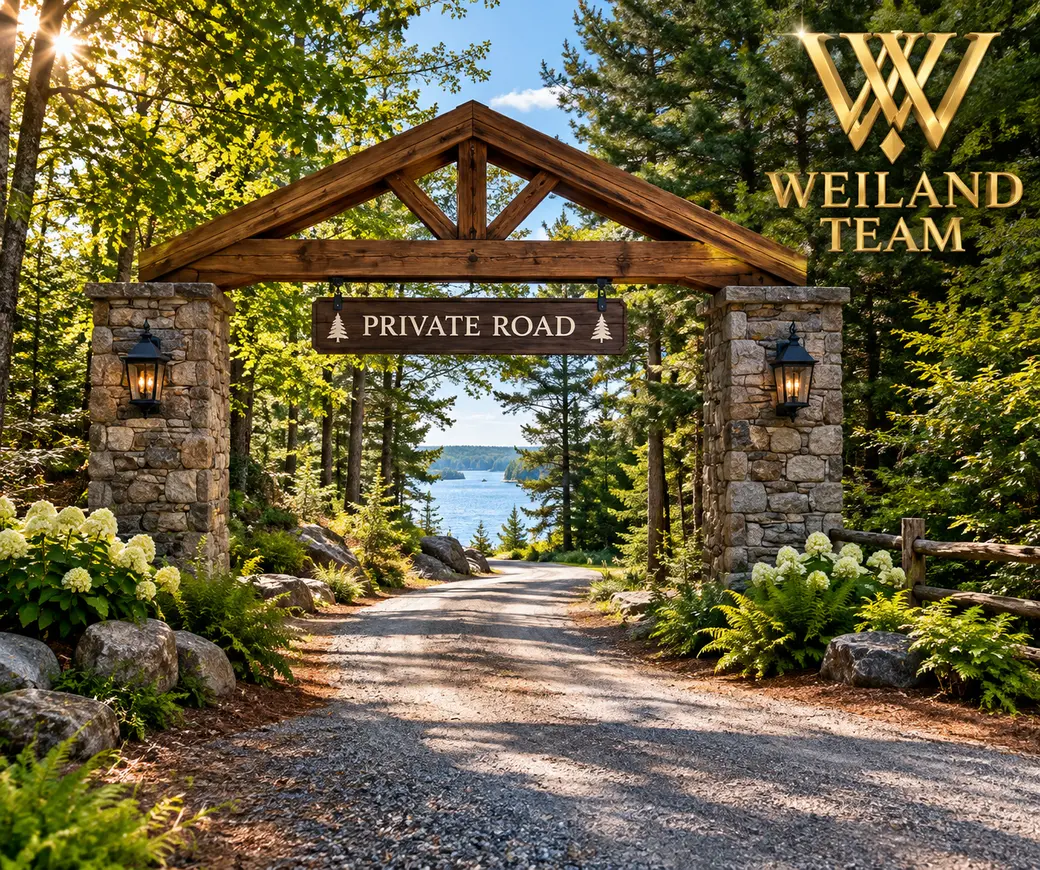
A peaceful private road winding through the forest can be part of what makes a cottage feel special.
But buyers should understand the legal access, maintenance responsibilities, winter conditions, road association structure and potential future costs before making a commitment.
When we evaluate Muskoka properties with buyers, private-road access is one of the practical details we pay close attention to because it can affect convenience, cost, financing, future construction and long-term enjoyment of the property.
Dee Dee Weiland brings an interior design and staging background, while Mark Weiland brings extensive business and negotiation experience. Together, the Weiland Team combines local Muskoka knowledge with the global reach of eXp Realty.
Because the road leading to your cottage should be part of the enjoyment — not an unexpected surprise after closing.
Your Muskoka Dream Starts With The Weiland Team.
Weiland Team | eXp Realty
Luxury Muskoka Real Estate
Serving Muskoka, Lake of Bays, Huntsville, Bracebridge, Gravenhurst, Muskoka Lakes and surrounding cottage country.
Categories
Recent Posts