

GET MORE INFORMATION
What Muskoka Cottage Buyers Need to Know About Flood Risk, Drainage & Spring Runoff
What Muskoka Cottage Buyers Need to Know About Flood Risk, Drainage & Spring Runoff
Buying a waterfront cottage in Muskoka means living close to one of the things that makes this region so extraordinary: the water.
But water levels change. Snow melts. Heavy spring rains arrive. The ground can become saturated, and the way water moves across a particular property in April can be very different from what a buyer sees during a beautiful July showing.
For Muskoka cottage buyers, flood risk should be evaluated property by property. Elevation, shoreline configuration, drainage, topography, spring runoff, historical high-water events and the location of cottages, docks and boathouses can all affect how an individual waterfront property responds to spring conditions.
Understanding those factors before purchasing is an important part of waterfront due diligence.
What Causes Spring Flooding in Muskoka?
Spring flooding in Muskoka can result from a combination of melting snow and ice, rainfall, snowpack, temperature, saturated ground, existing water levels and the physical characteristics of the watershed.
The spring thaw is commonly known as the spring freshet. As accumulated snow and ice melt, water enters Muskoka's lakes and rivers. Heavy rainfall or rapid warming can add considerably more water to the system.
The Muskoka River Watershed is also a large and complex cascading system. Water moves through interconnected lakes and rivers before eventually reaching Georgian Bay, and natural constrictions can limit how quickly large volumes of water move through portions of the watershed.
That means unusually high spring water cannot always be attributed to one single cause.
Ontario's review of the significant 2019 flood events in the Muskoka River Watershed provides additional information about the physical characteristics of the watershed and the factors that can influence flooding.
Read Ontario's review of flooding in the Muskoka River Watershed
Do Muskoka's Dams Prevent Flooding?
No. Dams within the Muskoka River Watershed help manage water levels, but Ontario specifically notes that they are not flood-control structures capable of preventing flooding during extreme conditions.
During periods of large-volume, rapid runoff, there can simply be more water entering the watershed than the system has capacity to store or move through quickly.
Ontario's flood review explains that the lakes regulated by dams within the Muskoka River Watershed have limited drawdown capacity. During significant runoff events, that capacity may be insufficient to substantially reduce peak flood levels.
For waterfront buyers, therefore, the more useful property-specific question is often not simply:
"Why did the lake get high?"
It is:
"What happens to this particular property when it does?"
Can a Muskoka Property Experience High Water Without Being in a Routinely Flood-Prone Area?
Yes. A property that does not routinely experience flooding can still be affected by an exceptional high-water event. That is different from purchasing a property or location with a history of recurring seasonal flooding.
Mark and I understand that distinction firsthand.
We owned a Muskoka waterfront property in an area that was not routinely flood-prone. Flooding was not something we regularly experienced.
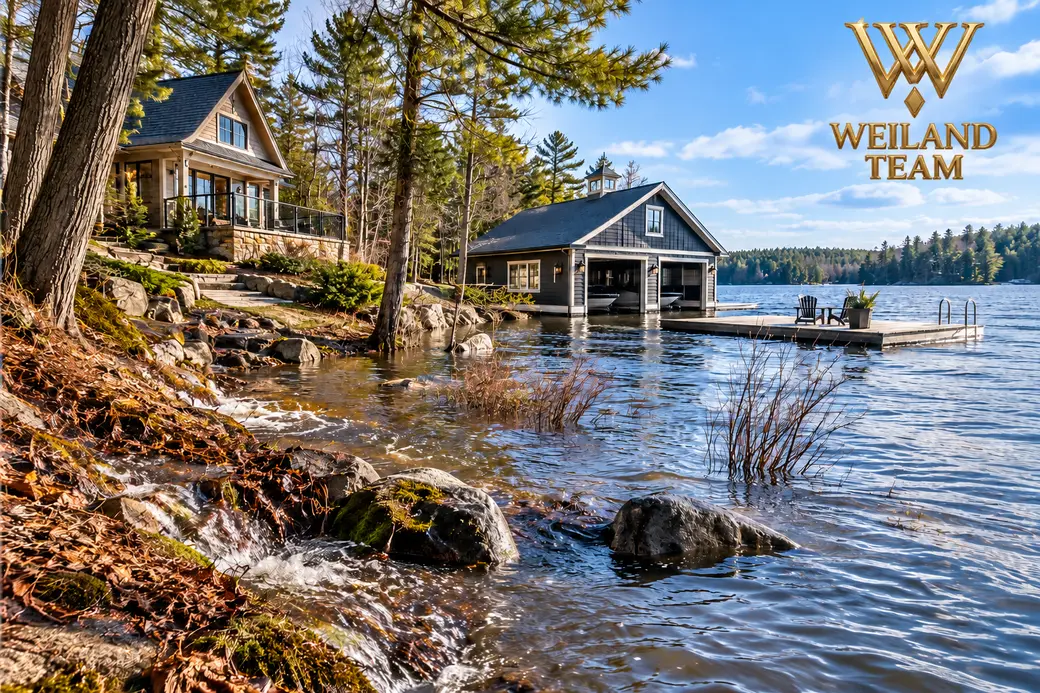
However, during one exceptional spring, the water rose enough that approximately two inches of water entered our boathouse.
Experiencing that firsthand gave us a much greater appreciation for what can happen when significant snowmelt, rainfall and high-water conditions come together.
It also reinforced something we believe is important for waterfront buyers:
An isolated high-water event and a history of recurring flooding are not the same thing.
The goal of good due diligence is to understand which situation applies to the property you are considering.
Are Some Muskoka Waterfront Properties More Susceptible to Flooding Than Others?
Yes. Flood vulnerability can vary substantially between Muskoka waterfront properties because of elevation, topography, shoreline configuration, proximity to rivers or constricted waterways and the location and elevation of buildings and shoreline structures.
This is why buyers should avoid making assumptions based solely on the name of the lake or community.
Two cottages on the same lake — or even relatively close to one another — can have very different physical characteristics.
One cottage may sit well above the shoreline with effective natural drainage, while another may occupy lower land where water behaves very differently during spring conditions.
What Should Buyers Look for When Viewing a Muskoka Waterfront Property?
Buyers should examine the entire property, not just the cottage. Look at elevation, grading, low areas, drainage patterns, shoreline structures and the likely path of rainwater and melting snow.
Questions worth considering include:
- How high is the cottage above the lake?
- Does the land slope naturally toward or away from the buildings?
- Are there low areas where water could collect?
- Where is melting snow likely to travel in the spring?
- Are there drainage swales, ditches or culverts?
- Does driveway runoff move toward or away from the cottage?
- Could runoff arrive from higher neighbouring land or exposed rock?
- How high are the dock and boathouse relative to typical water levels?
- Are there visible signs of previous moisture or water intrusion in a basement or crawlspace?
- Have drainage or grading improvements been made to the property?
A waterfront property can look completely dry during a summer showing while behaving very differently during the spring thaw or after prolonged heavy rainfall.
Why Does Drainage Matter Even When a Cottage Isn't at Significant Flood Risk?
Drainage problems do not require a lake or river to overflow. Water can reach a cottage from rainfall, melting snow, neighbouring elevations, rock outcroppings, driveways or saturated ground.
This makes grading around the cottage particularly important.
Buyers should consider where water will travel during a major rainstorm and during spring snowmelt.
Basements, crawlspaces, retaining walls, foundations and lower portions of the property may warrant additional attention when there are signs of previous moisture.
Where concerns exist, an appropriate qualified professional should be consulted rather than relying solely on what can be observed during a showing.
How Can Buyers Check Muskoka Floodplain Mapping?
The District Municipality of Muskoka provides floodplain mapping through Muskoka GeoHub to help property owners and buyers understand areas that may be vulnerable to seasonal flooding.
The District's updated Floodline and LiDAR Mapping 2.0 allows users to explore flood-prone areas in both 2D and 3D.
The District also provides hourly live water-level information for several monitored Muskoka lakes, including Lake Muskoka, Lake Rosseau, Lake of Bays, Mary Lake, Fairy Lake, Bala Bay and Go Home Lake.
Floodplain mapping can be an important part of a buyer's research, but it should not necessarily be interpreted in isolation. It should be considered together with the physical characteristics and history of the individual property, professional inspections, insurance considerations and other appropriate property-specific advice.
Explore District of Muskoka Floodplain Mapping
Explore Muskoka GeoHub and Mapping Resources
What Should Buyers Ask About a Cottage's Flooding History?
Buyers should ask about known flooding, unusually high-water events, water intrusion, spring runoff and drainage issues affecting the cottage and other structures on the property.
Don't stop with the question:
"Has the cottage ever flooded?"
Consider asking:
- Has water ever entered the cottage, basement or crawlspace?
- Has unusually high water ever reached the boathouse, bunkie or other shoreline structures?
- What typically happens to the property during the spring thaw?
- Are there areas where water regularly collects?
- Have drainage or grading improvements been completed?
- Have there been exceptional high-water years?
Where appropriate, historical information from people familiar with that particular area or stretch of shoreline may also provide useful context.
Historical experience cannot predict every future event, but it can help a buyer develop a more complete understanding of the property.
Why Should Buyers Pay Attention to the Boathouse and Dock?
Boathouses, docks and other shoreline structures can be affected by high water even when the cottage itself remains safely above the lake.
Their elevation, construction and location relative to the water therefore deserve attention during a waterfront purchase.
Our own experience illustrates this well. Our property was not in an area we considered routinely flood-prone, yet an exceptional high-water event still resulted in approximately two inches of water entering our boathouse.
For a buyer, the cottage is only one component of the waterfront property that should be evaluated.
Should Flood Risk Stop You From Buying a Muskoka Cottage?
Not necessarily. Understanding flood risk is about making an informed decision, not creating fear around waterfront ownership.
A well-elevated cottage with effective drainage may present very different considerations from a low-lying property with a history of recurring water problems.
Similarly, one unusual historical high-water event should not automatically be treated the same way as repeated seasonal flooding.
The objective is to understand the individual property before you buy it.
Frequently Asked Questions About Muskoka Cottage Flood Risk
Is flooding common in Muskoka?
Flooding does occur in Muskoka, particularly during significant spring events, but the degree of risk varies considerably by location and property. Buyers should investigate the individual waterfront property rather than assume that all Muskoka cottages face the same degree of flood risk.
What is the spring freshet in Muskoka?
The spring freshet is the seasonal thaw when accumulated snow and ice melt and water enters Muskoka's lakes and rivers. Rainfall, warming temperatures, snowpack, ground conditions and existing water levels can all influence the amount and timing of spring runoff.
Can a cottage experience high water even if the area isn't normally flood-prone?
Yes. Exceptional weather and watershed conditions can occasionally result in unusually high water in locations that do not routinely experience flooding. Buyers should distinguish between an isolated high-water event and a property or area with a history of recurring flooding.
How do I find out if a Muskoka cottage is in a floodplain?
The District Municipality of Muskoka provides floodplain mapping through Muskoka GeoHub. Buyers can use these resources as one component of their waterfront due diligence and seek appropriate professional or municipal guidance where further interpretation is required.
What drainage issues should I look for when buying a Muskoka cottage?
Look at grading around the foundation, the natural slope of the property, low areas, culverts, drainage channels, driveway runoff, surrounding elevations and the likely path of melting snow. Evidence of moisture or previous water intrusion should be investigated further.
Does Muskoka control lake levels to prevent flooding?
Water levels within the Muskoka River Watershed are managed through dams and operating plans, but Ontario states that the dams are not flood-control structures. During large-volume rapid runoff events, their ability to reduce peak flood levels can be limited.
Should I investigate flood risk before making an offer on a Muskoka waterfront cottage?
Yes. Flooding history, drainage, elevation, spring runoff and shoreline structures can all be relevant to a waterfront purchase. Depending on the property, buyers may also want to investigate floodplain mapping, insurance considerations and advice from appropriate qualified professionals.
Buying Muskoka Waterfront Is About Understanding the Entire Property
A beautiful view is only one part of a waterfront purchase.
At the Weiland Team, we believe buyers should understand the waterfront, shoreline, cottage, septic system, access, drainage, structures and other property-specific considerations that can affect ownership long after closing day.
Our own experience with an unusual Muskoka high-water event has given Mark and me firsthand appreciation for why these questions matter.
It doesn't mean buyers should be afraid of Muskoka waterfront.
It means they should be informed.
Because the best Muskoka purchase isn't simply the cottage that looks beautiful on showing day.
It's the one you understand before you own it.
Weiland Team | eXp Realty
Luxury Waterfront Real Estate in Muskoka, Lake of Bays & Surrounding Areas
LuxuryMuskokaRealEstate.com
Your Muskoka Dream Starts With The Weiland Team.
This article is provided for general educational purposes and is not a substitute for property-specific advice from municipal authorities, engineers, home inspectors, insurers, lawyers or other appropriate qualified professionals.
Categories
Recent Posts