

GET MORE INFORMATION
Buying a Cottage in Muskoka: The Complete Waterfront Due Diligence Guide
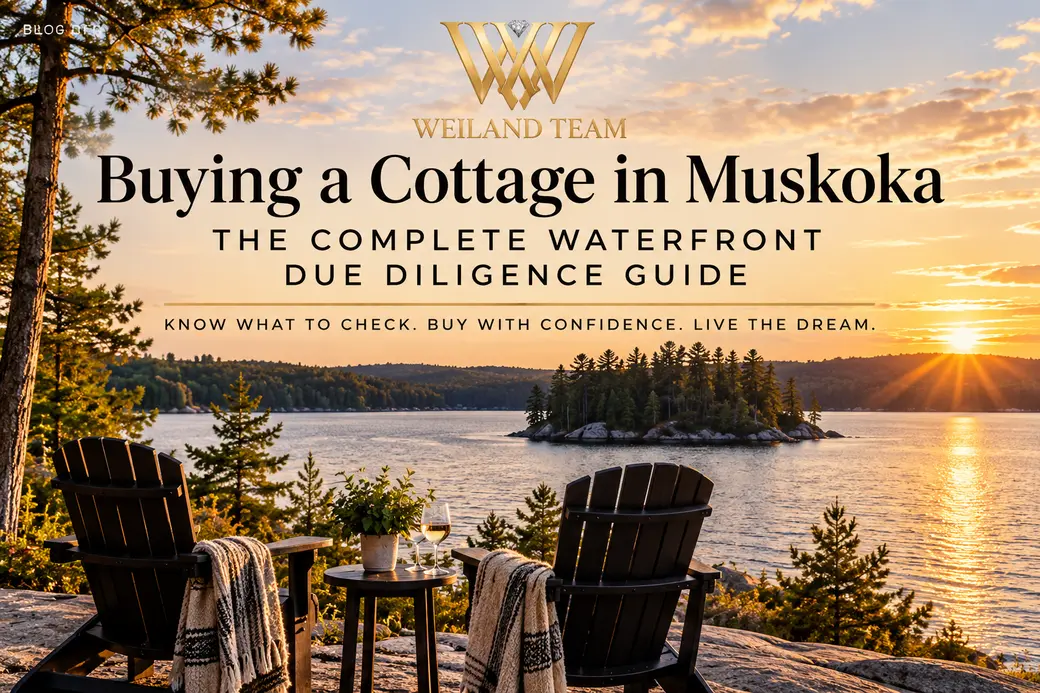
Buying a cottage in Muskoka can be one of the most exciting purchases you ever make.
It can also be one of the most complex.
Waterfront properties often involve considerations that simply do not exist with a typical urban home. Septic systems, wells or lake-water systems, shore road allowances, private roads, docks, boathouses, easements, shoreline setbacks, surveys, zoning and floodplain considerations can all affect how you use a property, what you may be able to change in the future and, ultimately, its value.
After years of living and working in Muskoka and helping buyers navigate waterfront properties throughout the region, Mark & I have learned that the most beautiful property is not necessarily the right property until the important questions have been answered.
Waterfront due diligence is about understanding exactly what you are buying before you become emotionally or financially committed to it.
This guide explains some of the most important things buyers should investigate when purchasing a cottage or waterfront property in Muskoka.
What Due Diligence Should You Do Before Buying a Cottage in Muskoka?
Before buying a Muskoka cottage, buyers should investigate the property’s title, access, shoreline, septic and water systems, surveys, zoning, permits, docks and boathouses, shore road allowance, insurance, flood considerations and any easements or rights-of-way affecting the property.
Not every property will require the same level of investigation, and requirements can vary by municipality and by the individual property.
A good waterfront due-diligence review may include:
- Reviewing the survey, if available
- Confirming property boundaries
- Understanding road ownership and access
- Reviewing septic-system information
- Investigating wells or lake-water systems
- Determining whether a shore road allowance exists and who owns it
- Reviewing zoning and permitted uses
- Confirming permits for cottages, additions, docks and boathouses
- Understanding easements and rights-of-way
- Reviewing floodplain information where applicable
- Investigating insurance availability and requirements
- Understanding shoreline characteristics, exposure and water depth
The purpose is not to make buying waterfront feel complicated.
It is to make sure that the property you fall in love with can actually support the way you intend to use it.
Why Is a Survey Important When Buying Muskoka Waterfront?
A survey can help identify property boundaries, shoreline configuration, structures, rights-of-way and possible encroachments. On waterfront property, where cottages, docks, boathouses, driveways and neighbouring structures may have existed for decades, this information can be extremely important.
Many older Muskoka properties were developed long before modern planning and building regulations existed.
A cottage may have been built close to a lot line. A neighbour’s driveway may cross part of the property. A boathouse may appear to sit directly in front of the cottage while the actual property lines tell a different story.
If there is an existing survey, review it carefully.
If the survey is old, determine whether it accurately reflects the structures currently on the property.
A survey is not simply a piece of paper in a closing file. It can help explain what you own and how the property is configured.
What Is a Shore Road Allowance in Muskoka?
An Original Shore Road Allowance, often called an OSRA, is a strip of land that may exist between a waterfront property and the water. Depending on the municipality and the individual property, that strip may still be municipally owned or may have previously been closed and conveyed to the property owner.
This surprises many buyers.
A cottage may visually appear to extend directly to the water, yet the legal ownership of the shoreline can be more complicated.
That is why shore road allowance ownership should be investigated during due diligence.
It can affect title, future shoreline projects and, in some cases, development opportunities.
Municipal rules differ across Muskoka, so buyers should never assume that the treatment of a shore road allowance in one municipality applies everywhere else.
For example, the Township of Muskoka Lakes updated its policy in 2026. As of June 10, 2026, the Township states that a property owner must own the Original Shore Road Allowance before a building permit can be issued for a boathouse, subject to the Township’s current process and any applicable conditional-permit provisions.
That is a perfect example of why buyers should verify the current rules for the specific municipality and property rather than relying on assumptions or old information.
Why Do Docks and Boathouses Require Special Attention?
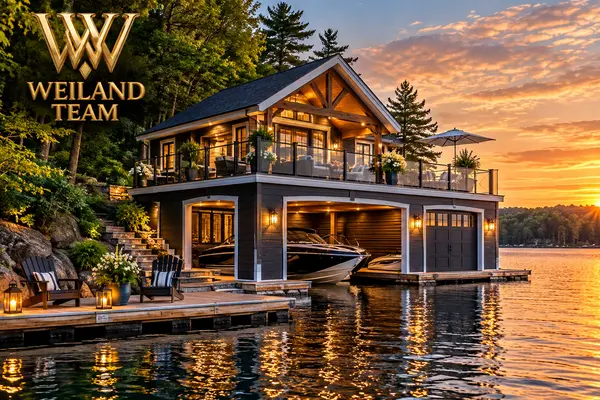
Docks and boathouses can add enormous enjoyment and value to a waterfront property, but buyers should confirm that existing shoreline structures are permitted and understand what may—or may not—be allowed in the future.
Never assume that because a dock or boathouse already exists, it can automatically be rebuilt, enlarged or replaced in the same form.
Municipal zoning, shoreline setbacks, lot frontage, lot coverage, shoreline activity areas and other regulations may affect future work.
The Township of Lake of Bays, for example, identifies building-permit requirements for the construction, installation or demolition of docks, boathouses and boat ports.
Other approvals may also be required depending on the location and nature of the project.
When a boathouse is a major part of the value of a property, we want buyers to understand both the structure that exists today and the rules that could affect it tomorrow.
How Important Is the Septic System When Buying a Cottage?
The septic system is one of the most important systems to investigate on a rural or waterfront property because its size, location, condition and capacity can affect both daily use and future renovations.
Buyers should try to understand:
- The age of the septic system
- The location of the tank and leaching bed
- The size and approved capacity
- When it was last pumped or serviced
- Whether permits or records are available
- Whether there have been repairs or replacements
- Whether the system appears appropriate for the way the cottage is currently being used
Bedroom count can be particularly important.
A property may physically contain more sleeping areas than the septic system was originally approved to support.
That distinction matters.
When buyers are considering an addition, extra bedrooms or a major renovation, septic capacity should be investigated before plans are made around what appears possible inside the cottage.
What Should Buyers Know About Wells and Lake-Water Systems?
Muskoka cottages may obtain water from a drilled well, dug well, lake-intake system or another private water source. Buyers should understand where the water comes from, how it is treated and whether the system meets their intended use of the property.
If a property has a well, buyers may want to review available records and consider appropriate water testing.
The Province of Ontario maintains Ontario well records, which can provide original construction information for many existing wells.
Lake-water systems may include pumps, intake lines, filters, ultraviolet treatment or other purification systems.
Some owners use additional drinking-water filtration or reverse-osmosis systems.
What matters is understanding what is installed, how it has been maintained and what will be required to operate it properly.
What Should You Know About Private Roads in Muskoka?
Private-road access can be perfectly suitable for a Muskoka property, but buyers should understand who owns the road, who maintains it, how expenses are shared and whether year-round access is available.
Questions may include:
- Is the road privately owned or subject to a right-of-way?
- Is there a formal road association?
- How are annual costs divided?
- Who handles grading and repairs?
- Who arranges snow removal?
- Is winter access reliable?
- Can emergency vehicles reach the property?
- Will the lender and insurer accept the access arrangement?
A winding cottage road under a canopy of trees can feel wonderfully private in July.
Buyers planning to use a property year-round also need to picture that same road during a January snowstorm.
What Are Easements and Rights-of-Way?
An easement or right-of-way may give another person the legal right to use part of a property or may provide the subject property with access over neighbouring land.
These arrangements are common enough in cottage country that they should not automatically alarm a buyer.
But they do need to be understood.
A right-of-way might provide driveway access.
A hydro easement could cross the land.
A neighbouring property may have a legal right to travel over a portion of the property.
The important questions are what rights exist, who benefits from them and whether they affect how you intend to use the land.
Your lawyer is an important part of reviewing title-related matters before closing.
Why Should Buyers Check Building Permits?
Building-permit records can help determine whether cottages, additions, decks, garages, docks, boathouses and other structures received required municipal approvals.
This can be especially important with older cottages that have changed substantially over the decades.
A beautiful addition may look seamless, but buyers should still ask whether permits were obtained and inspections completed.
The same applies to shoreline structures.
Municipal records can sometimes reveal valuable information about the history of the property and help buyers identify questions that deserve further investigation.
How Do Zoning and Setbacks Affect a Muskoka Cottage?
Zoning determines how a property may be used and can regulate matters such as setbacks, building height, lot coverage, shoreline development and permitted structures.
This becomes particularly important when a buyer intends to renovate, expand or rebuild.
A cottage that exists today may be considered legal non-complying or legal non-conforming depending on the circumstances.
That does not necessarily mean there is a problem.
It does mean future redevelopment may require careful planning.
Do not buy an older cottage assuming that because the existing building sits close to the lake, a completely new cottage could automatically be built in exactly the same location.
Before making major plans, speak with the appropriate municipal planning or building department and obtain professional advice specific to the property.
Should Buyers Investigate Flood Risk?
Yes. Floodplain information can be an important part of waterfront due diligence, particularly on properties located in areas known to experience seasonal flooding or fluctuating water levels.
The District Municipality of Muskoka Floodplain Mapping Project provides mapping intended to help identify areas that may be at greater risk of flooding and to support informed development and emergency-planning decisions.
Floodplain mapping should not be interpreted in isolation, but it can be one useful source of information when evaluating a property.
Buyers may also want to ask about past flooding, high-water events, shoreline erosion and whether any structures have historically experienced water-related damage.
How Do Shoreline, Water Depth and Exposure Affect Value?
The quality and usability of the waterfront can have a major influence on both enjoyment and value. Buyers should evaluate shoreline type, water depth, exposure, privacy, prevailing winds, boat traffic and how easily the water can be accessed.
Two cottages with similar buildings can feel completely different because of their waterfront.
A family with young children may value a shallow sandy entry.
A serious boater may prefer deep water at the dock.
Someone who dreams about sunsets may prioritize western exposure.
Another buyer may prefer morning sun and a cooler cottage later in the day.
Waterfront is not simply measured in feet.
Its quality, orientation and usability matter.
Why Does Topography Matter on Muskoka Waterfront?
Topography affects access, views, privacy, construction possibilities and how comfortably a property may function over time.
A steep lot may offer a spectacular elevated lake view.
It may also involve dozens of stairs between the cottage and the waterfront.
A level lot may be ideal for children, older family members or anyone who wants easy access to the dock.
When buyers first walk onto a dramatic property, the view can be so captivating that they barely notice the stairs.
We encourage buyers to think about how those stairs will feel carrying groceries, coolers, grandchildren, pets or boating gear—and how they may feel ten or twenty years from now.
Should Buyers Check Cottage Insurance Before Waiving Conditions?
Yes. Buyers should investigate insurance early, especially with older cottages, seasonal properties, wood-burning appliances, private roads or other features that may affect coverage.
Insurance requirements and availability can vary significantly depending on the property.
An insurer may ask about electrical systems, plumbing, heating, roof condition, wood stoves, distance from fire services, occupancy, road access and other characteristics.
Do not assume that a property will automatically qualify for the same type or cost of insurance as your current home.
Obtaining appropriate information early can prevent unwelcome surprises shortly before closing.
What Should You Look for During a Cottage Inspection?
A qualified home inspection can help identify visible issues involving the structure and major systems, but waterfront due diligence often extends beyond a standard home inspection.
Depending on the property, buyers may also consider specialists for septic systems, water systems, docks or boathouses, environmental concerns, structural issues or other property-specific matters.
The inspection should not be viewed as a pass-or-fail test.
Older Muskoka cottages often have quirks.
The question is whether you understand those quirks, their potential cost and whether you are comfortable accepting them.
What Red Flags Should Muskoka Cottage Buyers Watch For?
A red flag does not always mean a buyer should walk away. It means something deserves further investigation before the buyer proceeds.
| Potential Issue | What to Investigate |
|---|---|
| More bedrooms than expected | Septic approval, permits and legal use |
| Old or missing survey | Boundaries, encroachments and shoreline ownership |
| Private road | Legal access, maintenance, snow removal and insurance |
| Older boathouse or dock | Permits, zoning, OSRA ownership and rebuilding rights |
| Very steep lot | Long-term accessibility, stairs and maintenance |
| Evidence of water intrusion | Drainage, foundation, roof, shoreline and flood history |
| Major unverified renovation | Building permits and completed inspections |
How Should Buyers Think About Future Renovations?
Buy the property that exists today—not the property you assume you will be allowed to create tomorrow.
This is one of the most important pieces of advice we can give.
A buyer may walk into an older cottage and immediately imagine adding another bedroom, expanding toward the lake, building a larger boathouse or replacing the cottage entirely.
Those ideas may be possible.
But they should not be assumed.
Before paying a premium based on redevelopment potential, investigate zoning, setbacks, lot coverage, shoreline rules, septic capacity, OSRA ownership and any other approvals that may apply.
How Do You Balance Emotion With Due Diligence?
The best Muskoka purchases usually involve both emotion and careful analysis.
You should love the property.
There is nothing wrong with being emotional about a cottage.
This may become the place where your children learn to swim, where grandchildren gather, where holidays are celebrated and where your family creates memories for decades.
But emotion should not prevent you from asking difficult questions.
We often tell buyers that our job is to help them look beyond the sunset for a moment.
We can appreciate the view and still investigate the septic.
We can love the boathouse and still verify the permits.
We can imagine family summers while still examining the road, survey, insurance and shoreline.
Those things are not opposites.
They are what make an informed purchase possible.
Our Experience With Muskoka Waterfront Due Diligence
Having lived in Muskoka full-time since 2012 and having spent decades cottaging here before that, Mark & I understand how easily people can fall in love with a property.
We do too.
Sometimes it is the view.
Sometimes it is the shoreline.
Sometimes it is an extraordinary boathouse or a cottage that simply feels right the moment you walk through the door.
But our experience has also taught us that waterfront properties rarely tell their entire story during a showing.
A listing may say three bedrooms while a family has been using five sleeping spaces.
A beautiful boathouse may have limitations on future expansion.
A road between the cottage and the lake may completely change how one buyer feels about the property while another buyer barely notices it.
A steep lot may provide an incredible view but may not suit someone's long-term plans.
A shore road allowance, private road agreement or septic system can become far more important than it first appeared when buyers begin thinking about renovations or future use.
That is why we believe good buyer representation is not simply about finding a property.
It is about helping buyers understand the property they have found.
Frequently Asked Questions About Muskoka Waterfront Due Diligence
What is the most important thing to check before buying a Muskoka cottage?
There is no single issue that applies to every property. Buyers should review the combination of title, survey, road access, septic and water systems, shoreline ownership, zoning, permits, docks and boathouses, insurance and property condition. The most important questions depend on the specific cottage.
Do I need a survey when buying waterfront property?
A current survey can be extremely useful because it may show property boundaries, structures, rights-of-way and possible encroachments. If no current survey exists, discuss the circumstances with your lawyer and real estate representative and determine whether additional investigation is appropriate.
What is an Original Shore Road Allowance?
An Original Shore Road Allowance is a strip of land that may exist between a waterfront lot and the water. Depending on the property, it may still be municipally owned or may have been closed and conveyed to the property owner. Ownership and municipal requirements should be verified for the specific property.
Can I rebuild an existing Muskoka boathouse?
Not necessarily in exactly the same size or configuration. Current zoning, setbacks, lot frontage, shoreline rules, permits and shore road allowance ownership may affect what can be repaired, replaced or expanded. Buyers considering future boathouse work should investigate the applicable municipal rules before purchasing.
Should I inspect the septic system before buying?
Where appropriate, buyers should investigate the age, condition, location, capacity and available records for the septic system. Septic capacity can also be important if the buyer intends to add bedrooms or expand the cottage.
Are private roads a problem when buying a cottage?
Not necessarily. Many Muskoka properties are successfully accessed by private roads. Buyers should understand legal access, maintenance arrangements, costs, winter plowing, emergency access and whether the road arrangement is acceptable to their lender and insurer.
How can I check whether a Muskoka property is in a floodplain?
The District Municipality of Muskoka provides floodplain mapping for many lakes and rivers. Mapping can be a useful starting point, but property-specific professional and municipal advice may also be appropriate depending on the circumstances.
Can I assume an existing cottage addition or boathouse was permitted?
No. Existing structures should not automatically be assumed to have all required approvals. Municipal building and planning records may help confirm permits and inspections, particularly where substantial renovations or shoreline structures are involved.
Should I get cottage insurance arranged before closing?
Yes. It is wise to investigate insurance early in the buying process. Older buildings, wood-burning appliances, seasonal occupancy, private roads, electrical systems and distance from fire services can all affect availability or cost of coverage.
What is the biggest mistake buyers make with waterfront due diligence?
One of the biggest mistakes is assuming that what they see today automatically determines what they will be allowed to change tomorrow. Buyers considering renovations, additions, new docks or boathouses should investigate the current rules before basing their purchase decision on future development plans.
About Weiland Team
Weiland Team helps buyers and sellers navigate Muskoka real estate with a particular focus on luxury waterfront, cottages, year-round homes and lifestyle properties.
Dee Dee Weiland is a Luxury Real Estate Advisor with eXp Realty whose background in interior design and professional staging brings an additional perspective to property presentation, lifestyle and value. Mark Weiland brings extensive business and negotiation experience to the team.
Having lived in Muskoka full-time since 2012—and having spent decades cottaging here before that—we understand that waterfront real estate is about much more than bedrooms, bathrooms and square footage.
It is about understanding the lake, shoreline, access, structures, property systems and legal considerations that can affect how a cottage will actually work for you and your family.
If you are considering buying a cottage or waterfront property in Muskoka, we would be happy to help you ask the right questions, investigate the important details and make an informed decision.
Your Muskoka Dream Starts With The Weiland Team.
Categories
Recent Posts